
Comfort Promise Tools for Kids: 13 Months to 5 Years Old

At UCSF Benioff Children's Hospitals, we've made a Comfort Promise. What this means: We will do everything we can to make needle procedures as painless as possible for your toddler, preschooler or kindergartner.
Below you'll find details about simple pain-prevention tools and techniques for kids 13 months to 5 years old. Chronological age doesn't always match developmental age, so choose the age guidance you think will work best for your child.
Please note: The Comfort Promise Program is rolling out over time and is not yet available at all of our pediatric hospitals and clinics. To find out whether it's in effect in your child's unit, clinic or lab, check with the medical team there.
Numbing cream
Applied to the skin ahead of time, numbing cream can reduce or eliminate the pain of a needle poke.
If your child is staying at one of our hospitals, our staff will provide and apply numbing cream. But if you take them in for a clinic or lab visit, you may need to buy and apply it yourself.
What you'll need
- 4% lidocaine numbing cream, sold over the counter at pharmacies and drugstores or online.
- A "transparent film dressing" (a clear bandage with adhesive edges) to cover the numbing cream, sold over the counter at pharmacies and drugstores or online. Alternatively, you can simply use plastic wrap (cling wrap) to cover it.
How and when to apply it
Apply the cream 30 to 60 minutes before the procedure, and make note of the time you applied it. The numbing effect lasts one to two hours.
Ask your child's medical team where to apply the cream. The location will vary depending on the type of needle procedure.
For example, for children in this age range, vaccines are typically given in the upper arm or upper thigh, blood is usually drawn from the inner crook of the elbow, and IVs are inserted in the forearm, wrist or back of the hand. For multiple procedures, you may be advised to put cream in more than one spot – such as two spots on each arm.
Apply a quarter-size spot of cream in each location. A thick layer is usually best. Apply the dressing over the cream, and don't press on it.
If any cream is left on your child's skin after two hours, wipe it off.
Safety note: Keep numbing cream out of reach of children. If it gets in their eyes, nose or mouth, rinse thoroughly and call their doctor.
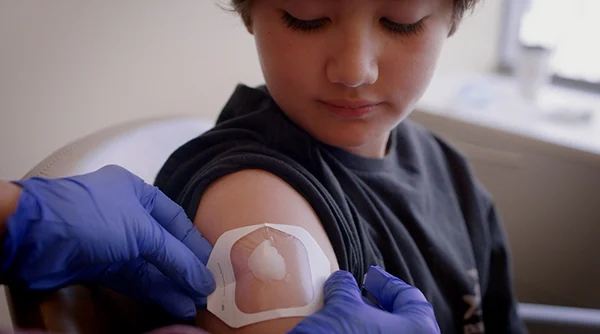
Numbing cream with transparent dressing
Comfort positioning
Certain positions help children feel more calm and secure. And that, in turn, can make needle procedures less painful.
Toddlers and preschoolers are probably most comfortable sitting upright on your lap, either chest-to-chest or back-to-chest, or in a side-sitting position.
Comfort positions to try
1 of 3
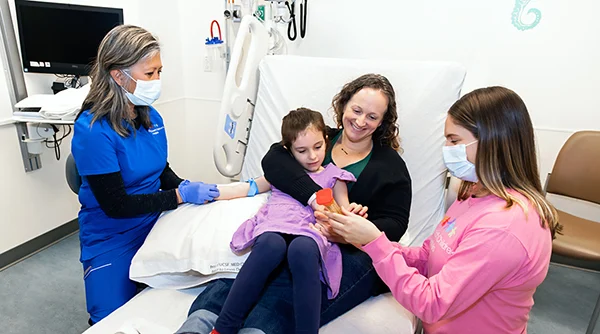
Back-to-chest
Distraction
Age-appropriate distractions can reduce children's pain by 20 to 50%. Here are some ideas to get you started. Every child is different, so you'll know best what to do.
- For toddlers. Bubbles, singing, music, board and pop-up books, light-up toys, toys that make noise, stories, a favorite stuffed animal or another object from home
- For preschoolers. Picture books, coloring or drawing, hand-held toys, bubbles, singing, music, games such as I Spy, a favorite stuffed animal or another object from home
- For kindergartners. A phone or tablet for watching videos, picture books, storytelling, bubbles, coloring or drawing, games such as I Spy, a favorite stuffed animal or another object from home, singing, music, deep breathing
Child's or caregiver's choices
Children who are old enough can use a start/pause or other communication sign to let us know when they're ready for the procedure. Alternatively, they can give us a thumbs-up when they're ready to begin and a thumbs-down if they need a break.
Your little one will pick up on your cues, so speak gently and keep your own breathing relaxed and slow. This helps both of you stay calm. We'll give you the option to pause a procedure if it's becoming too stressful for your child.
Memory shaping
Once your child is old enough to understand, the way you talk to them about their experience with a needle procedure makes all the difference in how they remember it. You can intentionally help them create a positive memory of it.
Research has shown that when this happens, your child will feel less scared and have less pain in future needle procedures. It'll also teach them how to better manage painful experiences – now and even into adulthood. Here's how to do it:
- Use positive language. Focus on aspects of the experience that went well. For example, "I know today was hard, but it was wonderful to see so many people helping you." "It's pretty cool that you got to watch your favorite show during the procedure." "You did such a great job holding still!"
- Correct any exaggerations. If your child seems to be recalling things as worse than they were, remind them of how things really went. For instance: "You didn't cry for a long time, just for a minute. Then we sang your favorite song together."
- Praise their coping skills. Emphasize how well they coped and how they did it. For example, "You hugged your teddy bear and looked away." "You took nice deep breaths and blew away the pain. You followed the instructions so well." "Even though you were nervous, you sat still. You were very brave!"
UCSF Benioff Children's Hospitals medical specialists have reviewed this information. It is for educational purposes only and is not intended to replace the advice of your child's doctor or other health care provider. We encourage you to discuss any questions or concerns you may have with your child's provider.
Related programs

The Comfort Promise at UCSF Benioff Children's Hospitals
Our team does everything possible to prevent and soothe your child's pain from needle procedures, using simple tools and techniques that really work.
Related reading

Comfort Promise Tools for Babies: Birth to 12 Months Old
Explore simple techniques to make vaccine injections, blood tests and other needle procedures as painless as possible for your baby.
Comfort Promise Tools for Kids: 6 to 12 Years Old
Explore simple techniques to make vaccine injections, blood tests and other needle procedures as painless as possible for your child.
Comfort Promise Tools for Teens: 13 to 17 Years Old
Explore simple techniques to make vaccine injections, blood tests and other needle procedures as painless as possible for your teenager.