
Comfort Promise Tools for Babies: Birth to 12 Months Old

At UCSF Benioff Children's Hospitals, we've made a Comfort Promise. What this means: We will do everything we can to make needle procedures as painless as possible for your baby.
Below you'll find details about simple pain-prevention tools and techniques for babies, from newborn to 12 months old. Take a look to see what you think will work best for your baby.
Please note: The Comfort Promise Program is rolling out over time and is not yet available at all of our pediatric hospitals and clinics. To find out whether it's in effect in your child's unit, clinic or lab, check with the medical team there.
Numbing cream
Applied to the skin ahead of time, numbing cream can reduce or eliminate the pain of a needle poke.
If your baby is staying at one of our hospitals, our staff will provide and apply numbing cream. But if you take your little one in for a clinic or lab visit, you may need to buy and apply it yourself.
Safety note: Do not use numbing cream on a baby who was born prematurely. To find out what you can try instead, ask your baby's medical team.
What you'll need
- 4% lidocaine numbing cream, sold over the counter at pharmacies and drugstores or online.
- A "transparent film dressing" (a clear bandage with adhesive edges) to cover the numbing cream, sold over the counter at pharmacies and drugstores or online. Alternatively, you can simply use plastic wrap (cling wrap) to cover it.
How and when to apply it
Apply the cream 30 to 60 minutes before the procedure, and make note of the time you applied it. The numbing effect lasts one to two hours.
Ask your baby's medical team where to apply the cream. The location will vary depending on the type of needle procedure.
For example, for babies, vaccines are typically given in the upper thigh, blood is usually drawn from the inner crook of the elbow, and IVs are inserted in the forearm, wrist or back of the hand. For multiple procedures, you may be advised to put cream in more than one spot – such as two spots on each thigh.
Apply a dime-size spot if your baby weighs less than 22 pounds and a quarter-size spot if they weigh more. A thick layer of cream is usually best. Apply the dressing over the cream, and don't press on it.
Make sure the numbing cream doesn't get in your baby's mouth. You'll need to be extra vigilant if you've applied cream to their hand. Secure the clear dressing or plastic wrap with tape, if needed.
If any cream is left on your baby's skin after two hours, wipe it off.
Safety note: Keep numbing cream out of reach of children. If it gets in your baby's eyes, nose or mouth, rinse thoroughly and call their doctor.
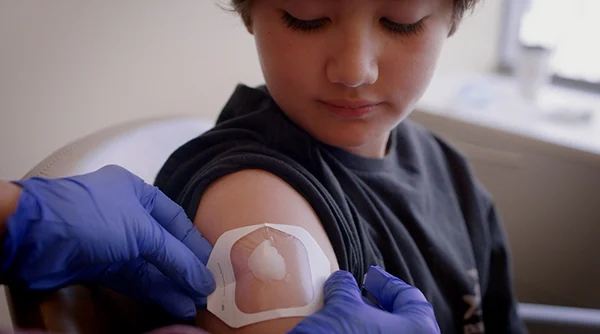
Numbing cream with transparent dressing
Comfort positioning
Certain positions help babies feel more calm and secure. And that, in turn, can make needle procedures less painful.
Whatever position you choose, avoid holding your baby too tightly or laying your baby flat on their back.
Babies who can't sit up on their own
- Swaddle them or go skin-to-skin so they can feel your comforting touch. Hold them in front of you, chest-to-chest.
- If swaddling, keep the body part where the needle will go uncovered and accessible.
- If doing skin-to-skin, remove your baby's clothing except for the diaper. Move or remove your own shirt so their skin is in contact with yours. If desired, drape a blanket over both of you for warmth or privacy.
Babies who can sit up on their own
- Undress your baby to expose the part of the body where the needle will be used.
- Hold your baby upright on your lap while giving them a warm hug, either back-to-chest or chest-to-chest. This helps babies feel secure and stay still.
Comfort positions to try
1 of 2
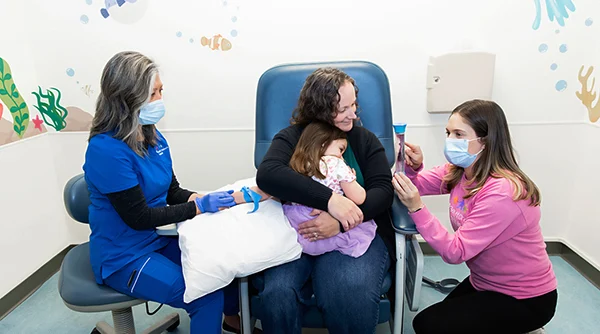
Chest-to-chest
Breastfeeding or sugar water
Babies who are breastfed or given sugar water (by pacifier or drip method) during a needle procedure tend to cry less and feel less pain.
Breastfeeding
Start nursing your baby one to two minutes before the procedure, making sure you have a good latch. Then continue nursing during and after it.
- Nursing your baby during needle procedures is safe, even for newborns.
- Your baby will not choke or associate you with pain.
- Breastfeeding combines being held close, a sweet taste and sucking, making it one of the best ways to reduce your baby's pain.
- Before you start breastfeeding, undress your baby to expose the part of the body where the needle will be used.
Soothing with sugar water
If breastfeeding isn't an option, you can offer sugar water, using a dropper or pacifier. We will provide sugar water for you to use at the clinic or hospital.
- Sugar water reduces babies' pain and is safe, even for newborns.
- Before offering sugar water, undress your baby to expose the part of the body where the needle will be used.
- Give your baby a drop of sugar water one or two minutes before the procedure, using a dropper or syringe to place it inside their mouth between cheek and gum. Give them one drop at a time and let them suck on the sweet taste.
- You can also dip a pacifier in sugar water (or drip sugar water on it) and give it to your baby before, during and after the needle procedure.
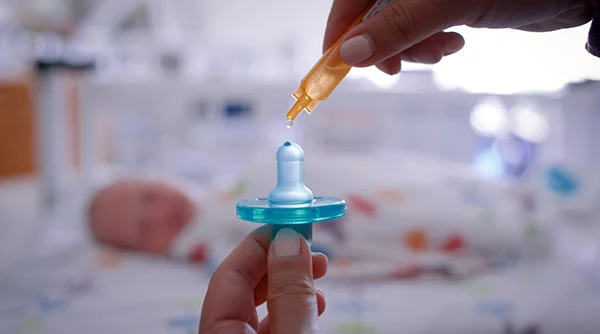
Sugar water being applied to a pacifier
Distraction
Age-appropriate distractions can reduce children's pain by 20 to 50%. Here are some ideas to get you started. Every baby is different, so you'll know best what to do for yours.
- For young babies. Singing, cooing, patting, talking, breastfeeding, pacifiers with sugar water, rattles, toys with high-contrast colors
- For premature babies. Soft, soothing talking, music or singing; no loud toys or toys with bright lights
- For older babies. Singing, talking, breastfeeding, bubbles, light-up toys, rattles, board books, stuffed animals, your baby's favorite blanket or object
Caregiver's choices
Your little one may pick up on your cues, so speak gently and keep your own breathing relaxed and slow. We'll give you the option to pause a procedure if it's becoming too stressful for your baby.
UCSF Benioff Children's Hospitals medical specialists have reviewed this information. It is for educational purposes only and is not intended to replace the advice of your child's doctor or other health care provider. We encourage you to discuss any questions or concerns you may have with your child's provider.
Related programs

The Comfort Promise at UCSF Benioff Children's Hospitals
Our team does everything possible to prevent and soothe your child's pain from needle procedures, using simple tools and techniques that really work.
Related reading

Comfort Promise Tools for Kids: 13 Months to 5 Years Old
Explore simple techniques to make vaccine injections, blood tests and other needle procedures as painless as possible for your toddler or preschooler.
Comfort Promise Tools for Kids: 6 to 12 Years Old
Explore simple techniques to make vaccine injections, blood tests and other needle procedures as painless as possible for your child.
Comfort Promise Tools for Teens: 13 to 17 Years Old
Explore simple techniques to make vaccine injections, blood tests and other needle procedures as painless as possible for your teenager.