From Oakland Preemie to Oakland NICU Nurse
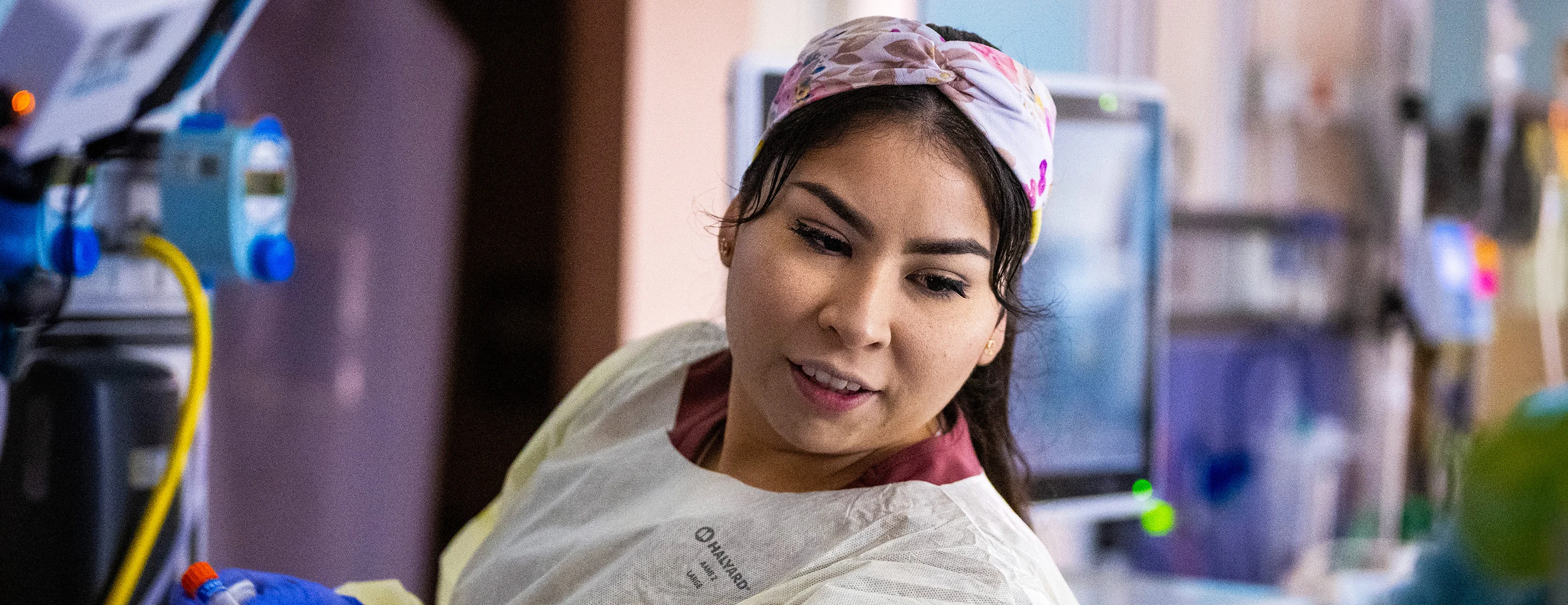
Nurse Roxana Gonzalez gently straightens a yellow crochet baby blanket, smoothing its lace-trimmed corners over an incubator. A tiny baby slumbers inside as classical music tinkles in the background. A continuous positive airway pressure (CPAP) machine softly bubbles away, helping the baby breathe.
It's midnight, and inside the neonatal intensive care unit (NICU) at UCSF Benioff Children's Hospital Oakland, Gonzalez and the other nurses are warming breast milk and formula for the night's first feed. The hospital is home to the East Bay's only level IV NICU, meaning it has the sophisticated equipment and highly trained staff to care for the sickest of newborns when other facilities cannot. Only two other level IV NICUs serve the Bay Area, one of which is UCSF Benioff Children's Hospital San Francisco.
About 400 infants are treated in Oakland's NICU each year. Many are born preterm with underdeveloped hearts and lungs, need surgical care, or are at risk of serious brain damage after difficult births. The hospital's highly specialized care draws seriously ill babies from as far away as Eureka, Reno and Modesto, where UCSF Benioff NICU doctors conduct outreach to improve medical care in the underserved Central Valley. A neonatologist is on call 24 hours a day to travel to other hospitals in cities like Castro Valley, Martinez and San Ramon to stabilize critically ill infants and, when needed, refer them here.
"Other hospitals refer to us when they don't have the unique equipment or the full team of specialists, or when they just can't find the right diagnosis and need help," says experienced neonatologist Dr. Arthur D'Harlingue, who works alongside specialists like pediatric cardiologists, neurologists and geneticists to meet each child's specific needs.
Most babies treated at UCSF Benioff Oakland live in underserved communities and are on government insurance. To make sure the hospital will continue to be a safety net for East Bay and California families – and provide world-class care – UCSF Health is investing $1.5 billion to modernize it, including NICU upgrades.
"The new hospital project is our covenant with the community to take care of all kids, regardless of their socioeconomic level," UCSF Benioff Children's Hospitals president Dr. Nicholas Holmes said recently. "UCSF Health is committed to creating the region's most comprehensive care network for kids, and UCSF Benioff Oakland is an integral piece of this vision."
Parents know they can call us at any time, and we'll be there to answer in their language while providing their child with the best care.
From preemie to night nurse
Born and bred in Oakland, nurse Roxana Gonzalez is a graduate of UCSF Benioff's Community Health and Adolescent Mentoring Program for Success (CHAMPS). The three-year internship program prepares Oakland teens of color for health care careers, helping to diversify the field and contribute to culturally competent care.
As a child, Gonzalez dreamed of becoming a pediatrician, but a stint with CHAMPS in the NICU changed her mind: "Nurses spent more time at the bedside caring for kids and their families – explaining things, helping with paperwork and making sure they had what they needed," she said.
Returning to Oakland as a registered nurse after attending UCLA's School of Nursing became her goal. Today, as a night nurse in the Oakland NICU, Gonzalez has come full circle in more ways than one. "I was a preemie," she says. "And when I was born, my mom had just come from Mexico. Not a lot of the nurses spoke Spanish, so she didn't really understand why I couldn't come home from the hospital – that always stuck with me."
Communication is key
Medical interpreters at UCSF Benioff Oakland are available 24 hours a day. Collectively, they're fluent in more than 200 languages, including Tagalog, Mandarin and Mam – a Mayan language spoken by many in Oakland's large Guatemalan community, as well as in Guatemala and parts of southern Mexico. Gonzalez is fluent in Spanish and says she's especially proud to serve the East Bay's large Spanish-speaking community.
"Parents know they can call us at any time, and we'll be there to answer in their language while providing their child with the best care," Gonzalez says.
"When I started, I cared for a baby born at 26 weeks. She weighed less than a kilo, but she was a fighter," Gonzalez remembers. "I would talk to her in Spanish because her mom talked to her in Spanish, and I think Mom and Dad really appreciated that."
When the little girl turned 1 year old in the NICU, Gonzalez and the staff decorated her highchair and celebrated. Although the toddler was still eating through feeding tubes, her parents were able to bring a small cupcake, Gonzalez remembers, and touch the icing to her lips for a photo.
"Parents appreciate the little things, like when you turn the crib camera on or use the special blanket they left," Gonzalez says. "It makes them feel at ease – and respected. It means a lot to me when parents tell me they'll sleep better knowing I'm here, even when they can't be."
Pioneering newborn care, then and now
True to its founding as the East Bay's first baby hospital more than 100 years ago, UCSF Benioff Oakland continues to be a pioneer in newborn care. In 1988, it was among the first five dozen facilities in the nation to introduce an advanced life support technique called ECMO (extracorporeal membrane oxygenation).
ECMO machines do what underdeveloped or damaged lungs and hearts can't: oxygenate blood and pump it throughout the body until the baby is strong enough to do it on their own. Today, UCSF Benioff Oakland is one of only a few hospitals in the state that provide ECMO, which can greatly improve the chances of survival for critically ill infants with lung or heart failure.
UCSF Benioff Oakland physicians were also among the first in the Bay Area to roll out a procedure called "therapeutic hypothermia." It uses specially designed machines that carefully lower a newborn's body temperature to prevent or limit brain damage caused by lack of oxygen or other injuries before or during birth.
Back in the NICU
On the night shift, Gonzalez has just tucked in one patient when a pair of tiny legs begin to kick awake in a nearby crib. She reaches into the bassinet, past a small webcam, to comfort the squirming baby. For parents of Oakland NICU babies, their child is always just a secure web stream away – even in the wee hours of the morning.
"You're so happy tonight," she says to the baby as she shifts a small, handstitched gold-and-blue square quilt above his cot. "I thought you were going to be grumpy."
Recognizing a familiar voice, he quiets down and begins to coo.
Graduation photo courtesy of Roxana Gonzalez
Other photos by Deanne Fitzmaurice
1 of 5
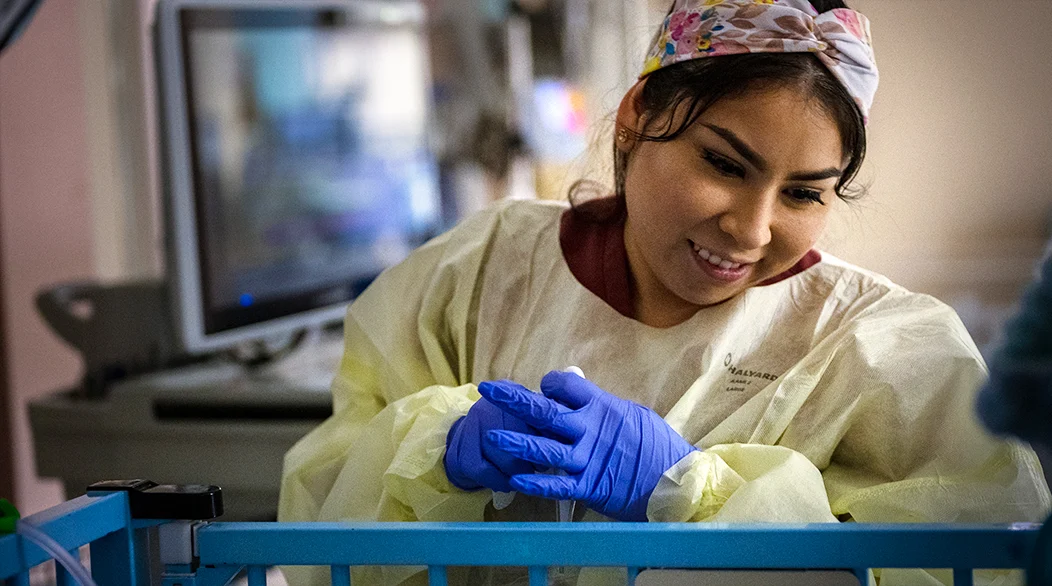
Passionate about caring for hospitalized babies and their families at the bedside, Roxana Gonzalez chose a career in nursing.